
Dr. A. Emre Karadeniz
Hair Transplant Surgeon
The International Society of Hair Restoration Surgeons (ISHRS) annual scientific meetings and workshops are an excellent environment for surgeons to meet, share experiences and have fun. Although this is supposed to be an international organisation, it is based in the USA and most meetings are organised in this country. It may be a 1-2 hour flight for most US members and a good occasion to meet colleagues, but for the rest of the world, especially Europeans, it costs a lot of time and energy to attend these meetings which may require two 25-hour journeys. When you consider the jet lag, in order for us to join these 4 day meetings we have to spare about 10 days from our daily life.
Together with my personal enthusiasm on the field of hair restoration surgery and sciences it is related with, the significant effort to attend ISHRS meetings motivates me even more in taking a more active role in these events, rather than taking this easy and seeing it more like a touristic opportunity. I would not feel that the goal of my trip were accomplished if I didn't make at least one or two scientific presentations each time.
Fortunately, the organisation committee has been giving me the honour by inviting me for two presentations each meeting since 2013. I would like to take this opportunity to briefly mention the topics I am going to talk on this year. I may share some other experiences later after I am back from this event.
Topic 1
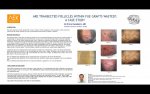
ARE TRANSECTED FOLLICLES WITHIN FUE GRAFTS WASTED?
This was a question that I have been trying to answer for the last couple of years. It is very important in determining whether FUE is a sound surgical technique or not.
The transection rate (the rate of transected follicles in FUE versus the total number of follicles attempted) in FUE is a sensitive topic. It is very unlikely that any surgeon in the world discloses his/her actual average transection rate and the transection rate he gets in each surgical session. Until recently, we were used to hearing some surgeons report 1-2% transection rates which most experienced surgeons knew was too good to be true. In practice it is very rare to get a transection rate below 10% with usual punch sizes between 0.75-0.85 mm in diameter. In my opinion 10-15% is a reasonable rate. For example, in the 2015 Mediterranean FUE Workshop held in Istanbul, I observed that there were a few sessions where the faculty surgeon was able to get around 10%; at the same time there were some sessions that I estimated this rate to be over 30%.
Anyway, the objective in this study was to find out what happens to these transected follicles, which is unavoidable. Do they die, or do they have the potential to yield mature hair? Please note that I am not talking about totally transected grafts; these are grafts that originally contained 2-4 follicles and some but not all of these follicles were transected. We can call these partially transected grafts. I will not go into the details of this study before I actually get the chance to present it, but my conclusion was that roughly half of the transected follicles within FUE grafts had the potential to yield mature hair at the recipient area. Some of the transected follicles that are left at the donor area may have the same potential (this was not evaluated in my study). If a transected follicle has the potential to grow mature hair both at the donor and recipient areas, this means that we have actually achieved surgical duplication of some follicles. This may be the main reason why it is possible to get results with FUE that are comparable with FUSS (strip surgery).
Topic 2
MEDICAL ETHICS IN HAIR RESTORATION SURGERY
This is another very sensitive and important topic. I will not go into the sub-topics I am planning to discuss in this panel before the event is over. However, if anyone has an important topic in mind that he thinks is worth discussing, I would like to hear it. I will share the details of this discussion later.
Together with my personal enthusiasm on the field of hair restoration surgery and sciences it is related with, the significant effort to attend ISHRS meetings motivates me even more in taking a more active role in these events, rather than taking this easy and seeing it more like a touristic opportunity. I would not feel that the goal of my trip were accomplished if I didn't make at least one or two scientific presentations each time.
Fortunately, the organisation committee has been giving me the honour by inviting me for two presentations each meeting since 2013. I would like to take this opportunity to briefly mention the topics I am going to talk on this year. I may share some other experiences later after I am back from this event.
Topic 1
ARE TRANSECTED FOLLICLES WITHIN FUE GRAFTS WASTED?
This was a question that I have been trying to answer for the last couple of years. It is very important in determining whether FUE is a sound surgical technique or not.
The transection rate (the rate of transected follicles in FUE versus the total number of follicles attempted) in FUE is a sensitive topic. It is very unlikely that any surgeon in the world discloses his/her actual average transection rate and the transection rate he gets in each surgical session. Until recently, we were used to hearing some surgeons report 1-2% transection rates which most experienced surgeons knew was too good to be true. In practice it is very rare to get a transection rate below 10% with usual punch sizes between 0.75-0.85 mm in diameter. In my opinion 10-15% is a reasonable rate. For example, in the 2015 Mediterranean FUE Workshop held in Istanbul, I observed that there were a few sessions where the faculty surgeon was able to get around 10%; at the same time there were some sessions that I estimated this rate to be over 30%.
Anyway, the objective in this study was to find out what happens to these transected follicles, which is unavoidable. Do they die, or do they have the potential to yield mature hair? Please note that I am not talking about totally transected grafts; these are grafts that originally contained 2-4 follicles and some but not all of these follicles were transected. We can call these partially transected grafts. I will not go into the details of this study before I actually get the chance to present it, but my conclusion was that roughly half of the transected follicles within FUE grafts had the potential to yield mature hair at the recipient area. Some of the transected follicles that are left at the donor area may have the same potential (this was not evaluated in my study). If a transected follicle has the potential to grow mature hair both at the donor and recipient areas, this means that we have actually achieved surgical duplication of some follicles. This may be the main reason why it is possible to get results with FUE that are comparable with FUSS (strip surgery).
Topic 2
MEDICAL ETHICS IN HAIR RESTORATION SURGERY
This is another very sensitive and important topic. I will not go into the sub-topics I am planning to discuss in this panel before the event is over. However, if anyone has an important topic in mind that he thinks is worth discussing, I would like to hear it. I will share the details of this discussion later.