

Dr. Josephitis
Valued member
Things have settled back down for us at the office, so I thought I would recap a bit about the 2015 Chicago ISHRS Conference[/b] as it is now a few weeks ago already. As you all have most likely heard, the conference was very well attended and had many new and interesting talks for the beginner and advanced hair surgeon alike. A major topic of the meeting had to do with the risks and benefits of doing FUE vs. FUT (aka strip, FUSS). It appeared to us that FUT may not be dead yet, and that there is a place for FUT just as there is for FUE. Dr. Ron Shapiro and I had been working on a study with the risks and benefits of FUE in mind, and I was honored to be able to present it at the conference in the opening session. The title of the talk was: A side-by- side study of 20 consecutive FUE patients comparing the use of a 0.9mm sharp vs. dull punch. [/b] I wanted to give the community a summary of our most interesting findings. The complete study will hopefully be published in an upcoming issue of the FORUM journal for hair transplant physicians.
Introduction:
It is challenging to study graft survival and the overall growth of transplants. There have been studies done for FUT which have shown very high survival rates. The survival rates of FUE, on the other hand, have not been studied as well. And comparing the two has also been a challenge. We know that years ago the results of FUE were not as good as they are today. We also know with modern FUE techniques and the increased experience of physicians today that the results are much better. Many practitioners today actually tout that the results are just as good as those of FUT. We thought a good place to start looking was at FUE punch types. There has been much controversy over the type of punch over the years. There are manual, motorized, and robotic FUE. There are different techniques and types of equipment within those as well. One thing that all of those types have is that they employ either a sharp or a dull punch (aka blunt).
Study Design:
We used 20 consecutive FUE patients and made 200 attempts with both a 0.9 dull and sharp punch. We tattooed and photographed the area. While most of our results were immediate (we looked at the data), we also wanted to compare how the donor looked after it healed comparing one to the other. For all the patients, we were looking at transection rate, hairs per graft, yield, speed, [/b]and scarring[/b]. We also recorded various characteristics of patients looking at age, follicle length, hair curl, skin texture[/b], and so on. We wanted to see if one patient fared better with one type of punch over another.
Results:
Transection rate[/b]. Transected grafts are those that have one or more hair cut. This cut can be anywhere along the length of the hair. Basically, it is not perfectly intact like a non-transected hair. This was the most surprising of our results. Initially, we had our staff record all of the data (transected hairs, grafts) as they had been doing for us for years. We were quite pleased with our initial results, as we were getting transection rate of less than 5% for the sharp and less than 2% for the dull. Sometimes, we were even getting rates less than 1% for the dull. We were very pleased with ourselves as we were doing what others in the field were doing if not even better at times. We decided to look even closer at those transected grafts. At same time, we had to change the way we documented our grafts. We used a dedicated technician to only record what she saw and to then pass the grafts on to others to be counted and sorted as usual. When we did this our numbers changed dramatically. Our transection rate was around 20% for the sharp and around 6% for the dull. The percentage increased because we were looking at every single hair that was transected. Other physicians with much lower percentages may not be recording these transections in this careful of a manner. It was quite a difference from our original data. Having done FUE with excellent results for many years at Shapiro Medical Group[/b], we had old data from which we could draw. We thought, as with all of hair transplantation, that experience might play a part. We checked our data from almost a year prior with the data from the most recent cases and there was no change. Now, although these percentages look much higher, we are still uncertain how important these transected hairs are. Many physicians believe most of these hairs do grow back.
Speed [/b]was an interesting finding for us. We thought the sharp punch would be slightly faster in extraction but it wasn t as each type was actually the same. For sharp we found an average of 22 minutes (537 grafts/hour) while with the dull we also got 22 minutes (540 grafts/hour) to obtain 200 grafts.
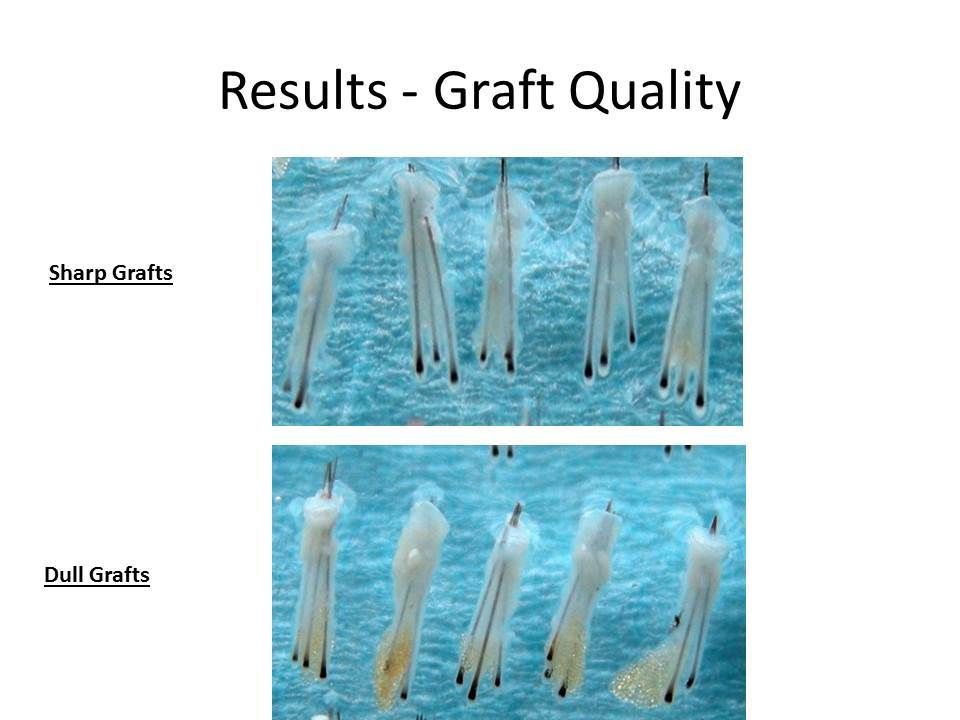
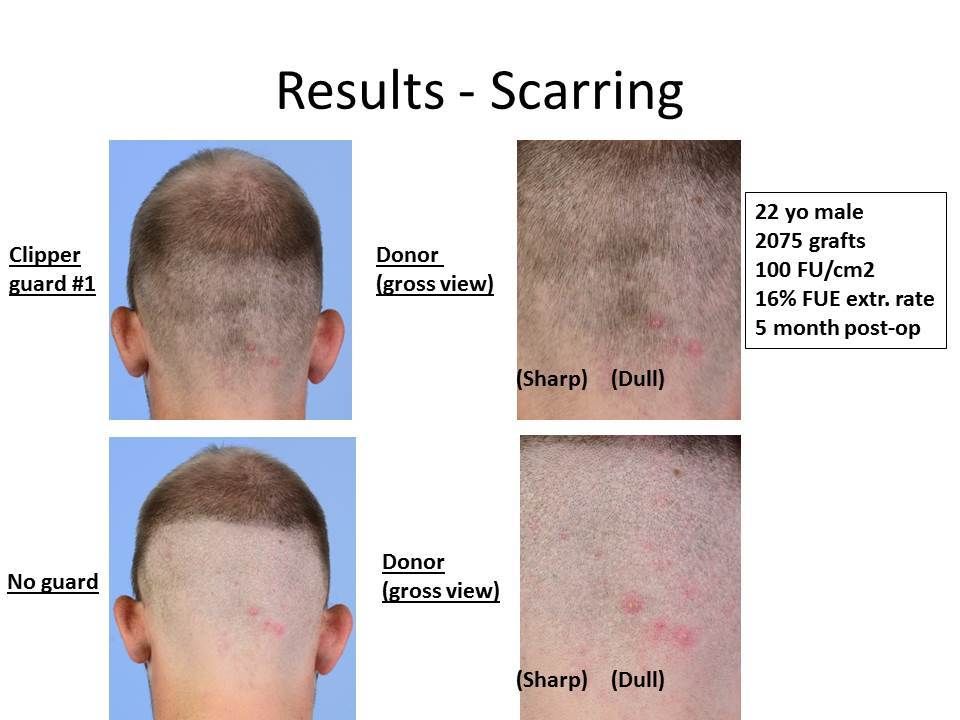
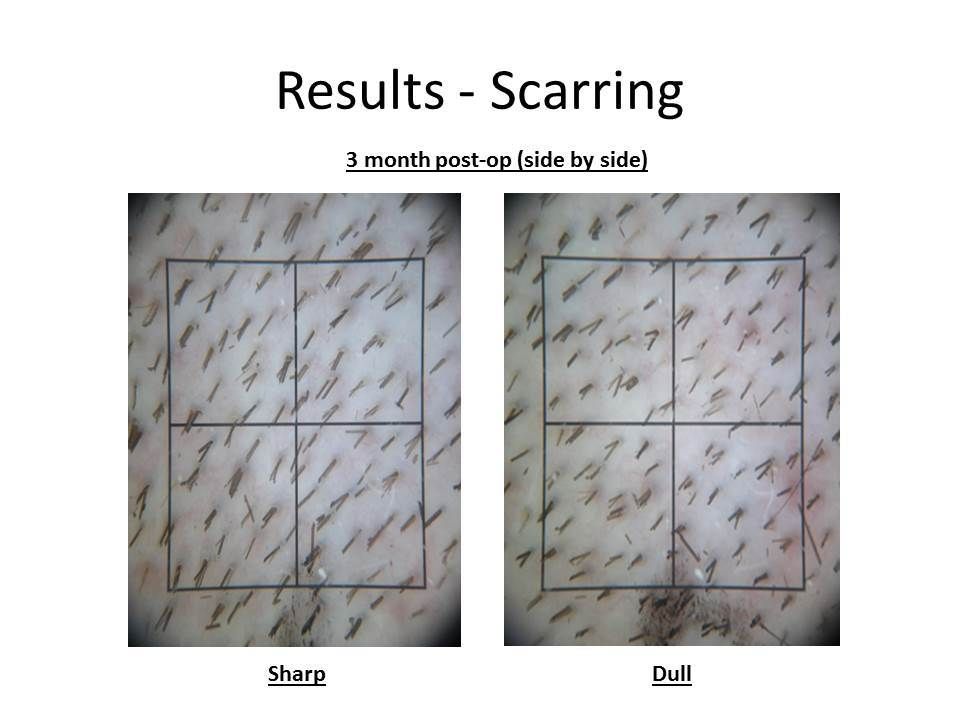
Scarring and Graft quality[/b] was looked at as well comparing both types. We tattooed an area so we could accurately find the same spot on the patients follow up. In addition to the scarring, we also looked at the general quality differences in the two types of punches. A couple of photos are included below that show how a majority of the dull grafts had more subtle fatty tissue below the bulbs of the grafts. Now, in some of the cases, there was virtually no difference between the two. As a rule though, we found more tissue with the dull punch. Also, below are a couple of photos of a patient with a closely cropped haircut. There is no difference here to be seen with the naked eye. On closer observation though, the dull appears to be spottier than the sharp. Again, for some patients, this magnified view showed no difference. The majority though, showed this slight difference.
Conclusion:
Transection rate appeared to be higher in the sharp punch group compared to the dull. We still are unsure of how important this difference is. Many of the transected grafts may and do grow well in the donor and recipient area. At this time, we are unsure of how many of these grafts grow back. The speed was the same for both groups. Scarring was not very noticeable for both groups, but the sharp group tended to be a little less obvious. This might be because there were more transected grafts in this group.
This study doesn t immediately change the way we perform FUE at Shapiro Medical Group[/b]. We will continue to use the techniques and instruments we feel are most appropriate for each patient. We also use what we know will be in the patient s best interest giving the optimal results. Some patients will benefit from the use of the dull punch, while with others the sharp punch may give better and more consistent grafts.
This is a thought provoking study which does show differences in different types of instruments. In the future, we hope to use the patient characteristic data that we also recorded to see if one type of patient would benefit from one type over the other. It would be helpful to know this information before we even begin the FUE procedure.
Introduction:
It is challenging to study graft survival and the overall growth of transplants. There have been studies done for FUT which have shown very high survival rates. The survival rates of FUE, on the other hand, have not been studied as well. And comparing the two has also been a challenge. We know that years ago the results of FUE were not as good as they are today. We also know with modern FUE techniques and the increased experience of physicians today that the results are much better. Many practitioners today actually tout that the results are just as good as those of FUT. We thought a good place to start looking was at FUE punch types. There has been much controversy over the type of punch over the years. There are manual, motorized, and robotic FUE. There are different techniques and types of equipment within those as well. One thing that all of those types have is that they employ either a sharp or a dull punch (aka blunt).
Study Design:
We used 20 consecutive FUE patients and made 200 attempts with both a 0.9 dull and sharp punch. We tattooed and photographed the area. While most of our results were immediate (we looked at the data), we also wanted to compare how the donor looked after it healed comparing one to the other. For all the patients, we were looking at transection rate, hairs per graft, yield, speed, [/b]and scarring[/b]. We also recorded various characteristics of patients looking at age, follicle length, hair curl, skin texture[/b], and so on. We wanted to see if one patient fared better with one type of punch over another.
Results:
Transection rate[/b]. Transected grafts are those that have one or more hair cut. This cut can be anywhere along the length of the hair. Basically, it is not perfectly intact like a non-transected hair. This was the most surprising of our results. Initially, we had our staff record all of the data (transected hairs, grafts) as they had been doing for us for years. We were quite pleased with our initial results, as we were getting transection rate of less than 5% for the sharp and less than 2% for the dull. Sometimes, we were even getting rates less than 1% for the dull. We were very pleased with ourselves as we were doing what others in the field were doing if not even better at times. We decided to look even closer at those transected grafts. At same time, we had to change the way we documented our grafts. We used a dedicated technician to only record what she saw and to then pass the grafts on to others to be counted and sorted as usual. When we did this our numbers changed dramatically. Our transection rate was around 20% for the sharp and around 6% for the dull. The percentage increased because we were looking at every single hair that was transected. Other physicians with much lower percentages may not be recording these transections in this careful of a manner. It was quite a difference from our original data. Having done FUE with excellent results for many years at Shapiro Medical Group[/b], we had old data from which we could draw. We thought, as with all of hair transplantation, that experience might play a part. We checked our data from almost a year prior with the data from the most recent cases and there was no change. Now, although these percentages look much higher, we are still uncertain how important these transected hairs are. Many physicians believe most of these hairs do grow back.
Speed [/b]was an interesting finding for us. We thought the sharp punch would be slightly faster in extraction but it wasn t as each type was actually the same. For sharp we found an average of 22 minutes (537 grafts/hour) while with the dull we also got 22 minutes (540 grafts/hour) to obtain 200 grafts.
Scarring and Graft quality[/b] was looked at as well comparing both types. We tattooed an area so we could accurately find the same spot on the patients follow up. In addition to the scarring, we also looked at the general quality differences in the two types of punches. A couple of photos are included below that show how a majority of the dull grafts had more subtle fatty tissue below the bulbs of the grafts. Now, in some of the cases, there was virtually no difference between the two. As a rule though, we found more tissue with the dull punch. Also, below are a couple of photos of a patient with a closely cropped haircut. There is no difference here to be seen with the naked eye. On closer observation though, the dull appears to be spottier than the sharp. Again, for some patients, this magnified view showed no difference. The majority though, showed this slight difference.
Conclusion:
Transection rate appeared to be higher in the sharp punch group compared to the dull. We still are unsure of how important this difference is. Many of the transected grafts may and do grow well in the donor and recipient area. At this time, we are unsure of how many of these grafts grow back. The speed was the same for both groups. Scarring was not very noticeable for both groups, but the sharp group tended to be a little less obvious. This might be because there were more transected grafts in this group.
This study doesn t immediately change the way we perform FUE at Shapiro Medical Group[/b]. We will continue to use the techniques and instruments we feel are most appropriate for each patient. We also use what we know will be in the patient s best interest giving the optimal results. Some patients will benefit from the use of the dull punch, while with others the sharp punch may give better and more consistent grafts.
This is a thought provoking study which does show differences in different types of instruments. In the future, we hope to use the patient characteristic data that we also recorded to see if one type of patient would benefit from one type over the other. It would be helpful to know this information before we even begin the FUE procedure.